


 Jeanne's House 04
Click on the image to go full screen.
More
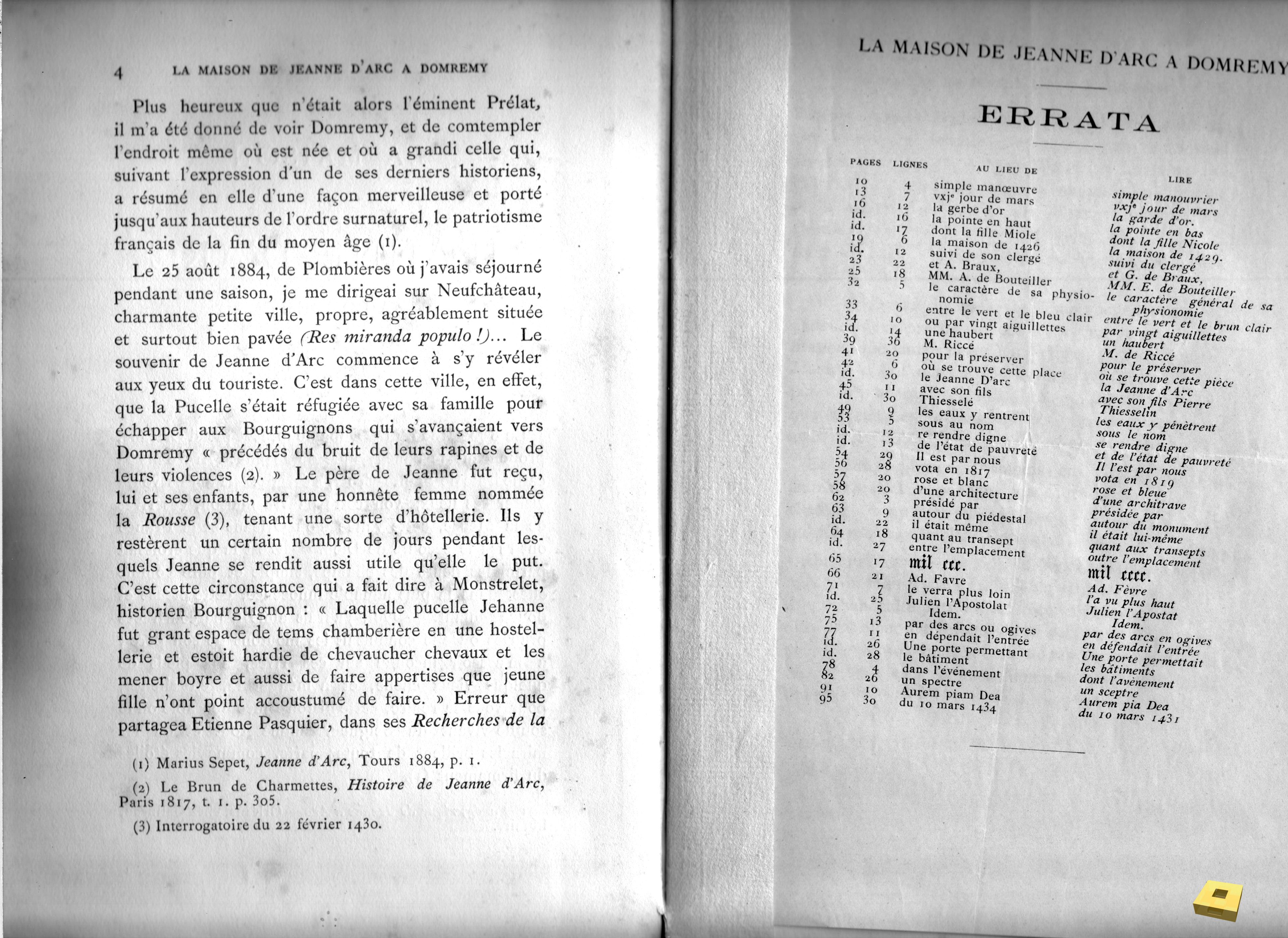
fortunate
than
the
eminent
Prelate
was
then,
I
was
given
the
opportunity
to
see
Domremy,
and
to
contemplate
the
very
place
where
she
was
born
and
grew
up,
who,
according
to
the
expression
of
one
of
its
last
historians,
summed
up
in
herself
in
a
marvelous
way
and
carried
to
the
heights
of
the
supernatural
order,
the
French
patriotism
of
the
end
of
the
Middle
Ages
(1).
On
August
25,
1884,
from
Plombières
where
I
had
stayed
for
a
season,
I
headed
for
Neufchâteau,
a
charming
little
town,
clean,
pleasantly
situated
and
above
all
well
paved
(Res
miranda
populo!)...
The
memory
of
Joan
of
Arc
begins
to
reveal
itself
there
to
the
eyes
of
the
tourist.
It
was
in
this
city,
in
fact,
that
the
Maid
had
taken
refuge
with
her
family
to
escape
the
Burgundians
who
were
advancing
towards
Domremy
"preceded
by
the
noise
of
their
plunder
and
their
violence
(2)."
Joan's
father
was
received,
he
and
his
children,
by
an
honest
woman
named
la
Rousse
(3),
who
ran
a
sort
of
hostelry.
They
stayed
there
for
a
certain
number
of
days
during
which
Joan
made
herself
as
useful
as
she
could.
It
was
this
circumstance
that
made
Monstrelet,
a
Burgundian
historian,
say:
"Which
maid
Joan
was
for
a
long
time
a
chambermaid
in
an
inn
and
was
bold
enough
to
ride
horses
and
lead
them
to
bed
and
also
to
make
appertises
that
young
girls
are
not
accustomed
to
doing."
An
error
shared
by
Etienne
Pasquier,
in
his
Research
on
the
(1)
Marius
Sepet,
Jeanne
d'Arc,
Tours
1884,
p.
1.
(2)
Le
Brun
de
Charmettes,
History
of
Joan
of
Arc,
Paris
1817,
t.
1.
p.
305.
(3)
Interrogation
of
February
22,
1430.


