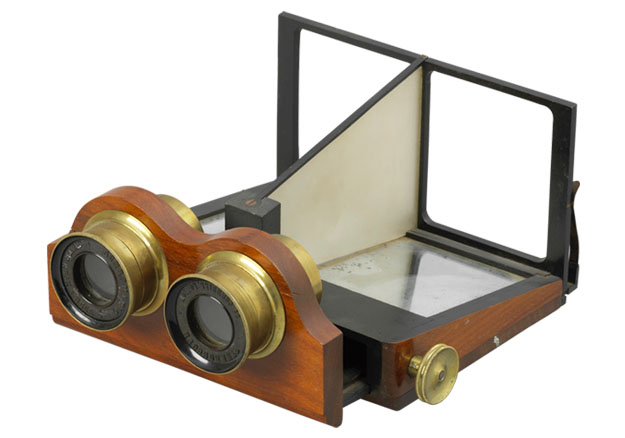
Displaying stereoscopic photos
Use the R key on your keyboard to go back to where you came from!
The stereoscopic view displays the following button:

qui
permet
de
basculer
la
vue
en
2D
ou
revenir
en
3D.
Cliquez dans la photo pour l'afficher en plein écran (ou pour revenir en mode fenêtré !)
The
different
modes
available
in
“More
options”:
-
Help:
this
help
page
-
CAC50:
side
by
side
50%
-
CAC
00:
side
by
side
100%
-
Crossed:
3D
view
without
glasses
(you
have
to
squint)
-
Dubois:
advanced
color
anaglyph
-
Anag-C:
color
anaglyph
-
Anag-N:
black
and
white
anaglyph
-
Sync-H:
horizontal
sync
3D
monitor
-
Sync-V:
vertical
sync
3D
monitor
-
L-R:
left
eye
↔
right
eye
inversion
 In
anaglyph
mode,
red
is
on
the
left
eye...
In
anaglyph
mode,
red
is
on
the
left
eye...
View
photos
at
least
60
cm
from
your
monitor.
If
your
eyes
hurt,
move
away
from
your
monitor.
Preferably,
switch
to
full
screen,
turn
off
the
lights
or
close
your
shutters
to
better
immerse
yourself
in
3D.
Switch
your
TV
/
screen
to
"dynamic"
mode
to
compensate
for
the
loss
of
brightness
due
to
the
glasses.
The
mouse
is
hidden
in
the
photos
to
avoid
headaches.
Note:
10%
of
the
world's
population
cannot
see
3D
stereoscopy,
neither
in
real
life
nor
on
screen:
use
the
"2D"
menu
to
see
the
photo
in
2D
Supported 3D displays:
On computers
Autostereoscopic
displays
using
vertical
interlacing
Active
LCD
glasses
(shutter
glasses)
(horizontal
or
vertical
interlacing
or
'page-flip'
mode).
This
mode
requires
the
Winx3D
driver,
the
NVidia
stereo
driver
or
a
graphics
card
supporting
quad-buffer
mode
with
OpenGL.
Winx3D
is
no
longer
available
on
the
original
website.
This
has
been
discussed
on
the
'stereo3d'
forum.
Alternatively,
the
RivaTuner
software
can
be
used
to
"patch"
an
NVidia
GeForce
card
to
"Quadro"
thus
making
OpenGL
stereo
mode
and
other
"professional"
features
available.
OpenGL
stereo
is
the
only
mode
that
allows
stereoscopic
display
in
a
normal
window.
On televisions
any 3D-compatible television with a web browser
History :
Three
hundred
years
before
our
era,
Euclid
understood
that
our
notion
of
relief
was
due
to
the
fact
that
our
eyes
see
two
different
images.
The
first
attempts
at
stereoscopic
vision
(3D)
appeared
around
1613
(François
D'Aquilon)
The
first
stereoscopic
color
film
was
shot
by
M.
A.
Hitchcock:
Murder
Was
Perfect
-
1954
Mainstream
3D
really
took
off
with
J.
Cameron's
film
Avatar
in
2009
In
2025,
the
fashion
for
stereoscopy
passed...
in
France,
because
it
exploded
in
China.
The
4th
wave
"stereoscopy"
will
return
to
France
with
the
popularization
of
8k
screens,
which
allow
3D
without
glasses
with
very
good
viewing
comfort.