


 Sion, N.D. stained glass window
Click on the image to go full screen.
This stained glass window is dedicated to Saint Albert the Great (Sanctus Albertus).
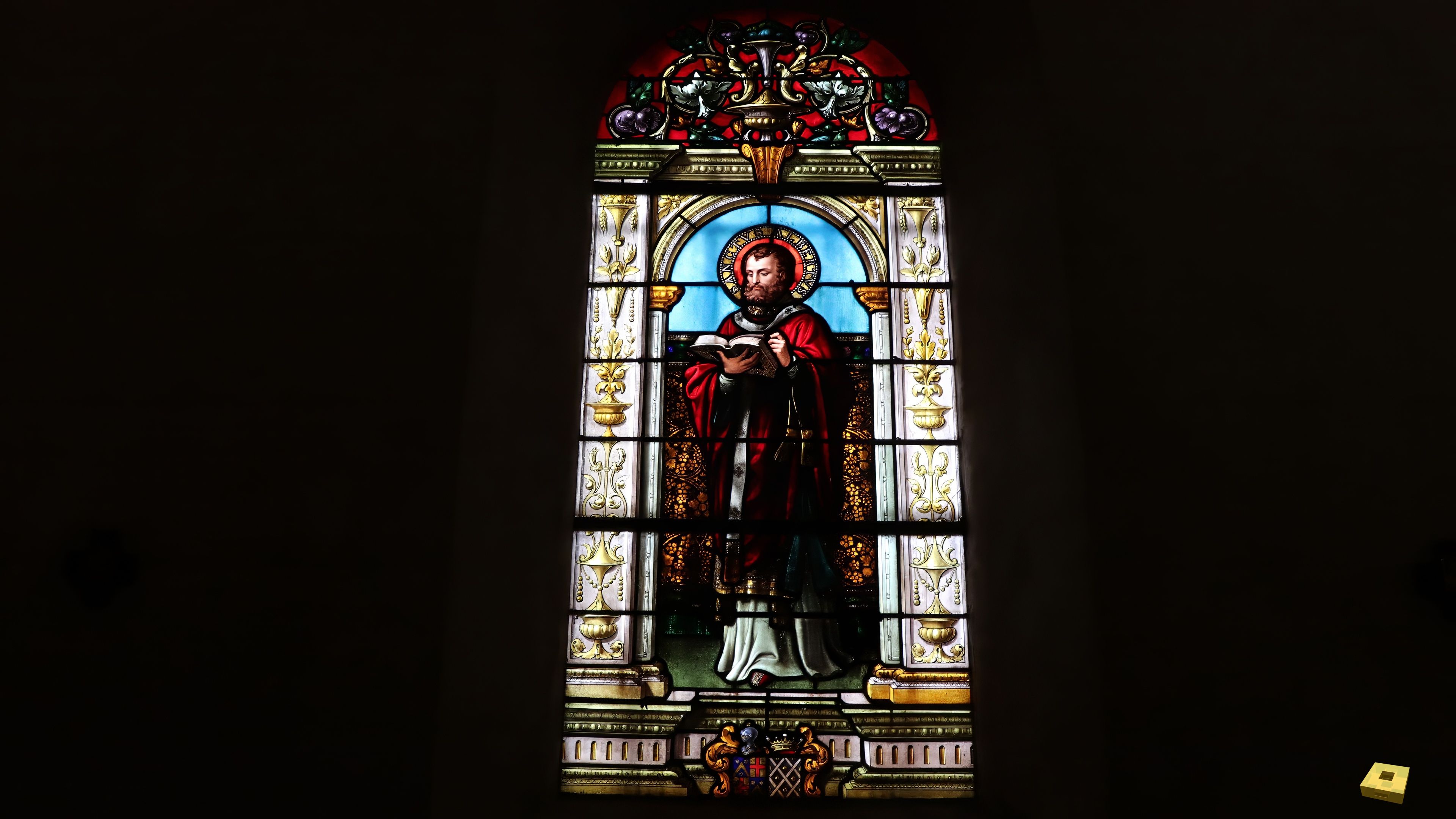
Saint Albert the Great is depicted standing in an architectural niche. He is dressed in a red bordered cope, a liturgical garment signifying his rank as bishop and his ecclesiastical dignity. In his hands, he holds an open book, a symbol of his immense knowledge and his role as a theologian and philosopher. His right hand seems ready to turn a page, expressing a constant quest for truth and understanding. His halo, bearing the inscription Sanctus Albertus, confirms his status as a canonized saint. It is a central element of Christian iconography, designating sanctified figures. The architectural niche, the columns richly decorated with golden floral motifs and the semicircular vault give the figure a majestic aura, evoking a miniature cathedral. The bright colors – particularly intense reds and blues – emphasize the solemnity of the scene, while drawing the eye towards the saint. These tones, characteristic of neo-Gothic glasswork, are reinforced by the golden motifs of the columns that frame the scene. The presence of the coat of arms at the bottom of the stained glass window underlines the local context or the dedication of the patrons of the work. The helmet, the crown and the heraldic motifs attest to the importance of this commission in the history of the church.Saint Albert the Great is depicted standing in an architectural niche. He is dressed in a red bordered cope, a liturgical garment signifying his rank as bishop and his ecclesiastical dignity. In his hands, he holds an open book, a symbol of his immense knowledge and his role as a theologian and philosopher. His right hand seems ready to turn a page, expressing a constant quest for truth and understanding. His halo, bearing the inscription Sanctus Albertus, confirms his status as a canonized saint. It is a central element of Christian iconography, designating sanctified figures. The architectural niche, the columns richly decorated with golden floral motifs and the semicircular vault give the figure a majestic aura, evoking a miniature cathedral. The bright colors – particularly intense reds and blues – emphasize the solemnity of the scene, while drawing the eye towards the saint. These tones, characteristic of neo-Gothic glasswork, are reinforced by the golden motifs of the columns that frame the scene. The presence of the coat of arms at the bottom of the stained glass window underlines the local context or the dedication of the patrons of the work. The helmet, the crown and the heraldic motifs attest to the importance of this commission in the history of the church.
Saint Albert the Great is depicted standing in an architectural niche. He is dressed in a red bordered cope, a liturgical garment signifying his rank as bishop and his ecclesiastical dignity. In his hands, he holds an open book, a symbol of his immense knowledge and his role as a theologian and philosopher. His right hand seems ready to turn a page, expressing a constant quest for truth and understanding. His halo, bearing the inscription Sanctus Albertus, confirms his status as a canonized saint. It is a central element of Christian iconography, designating sanctified figures. The architectural niche, the columns richly decorated with golden floral motifs and the semicircular vault give the figure a majestic aura, evoking a miniature cathedral. The bright colors – particularly intense reds and blues – emphasize the solemnity of the scene, while drawing the eye towards the saint. These tones, characteristic of neo-Gothic glasswork, are reinforced by the golden motifs of the columns that frame the scene. The presence of the coat of arms at the bottom of the stained glass window underlines the local context or the dedication of the patrons of the work. The helmet, the crown and the heraldic motifs attest to the importance of this commission in the history of the church.


