


 Jeanne's House 08
Click on the image to go full screen.
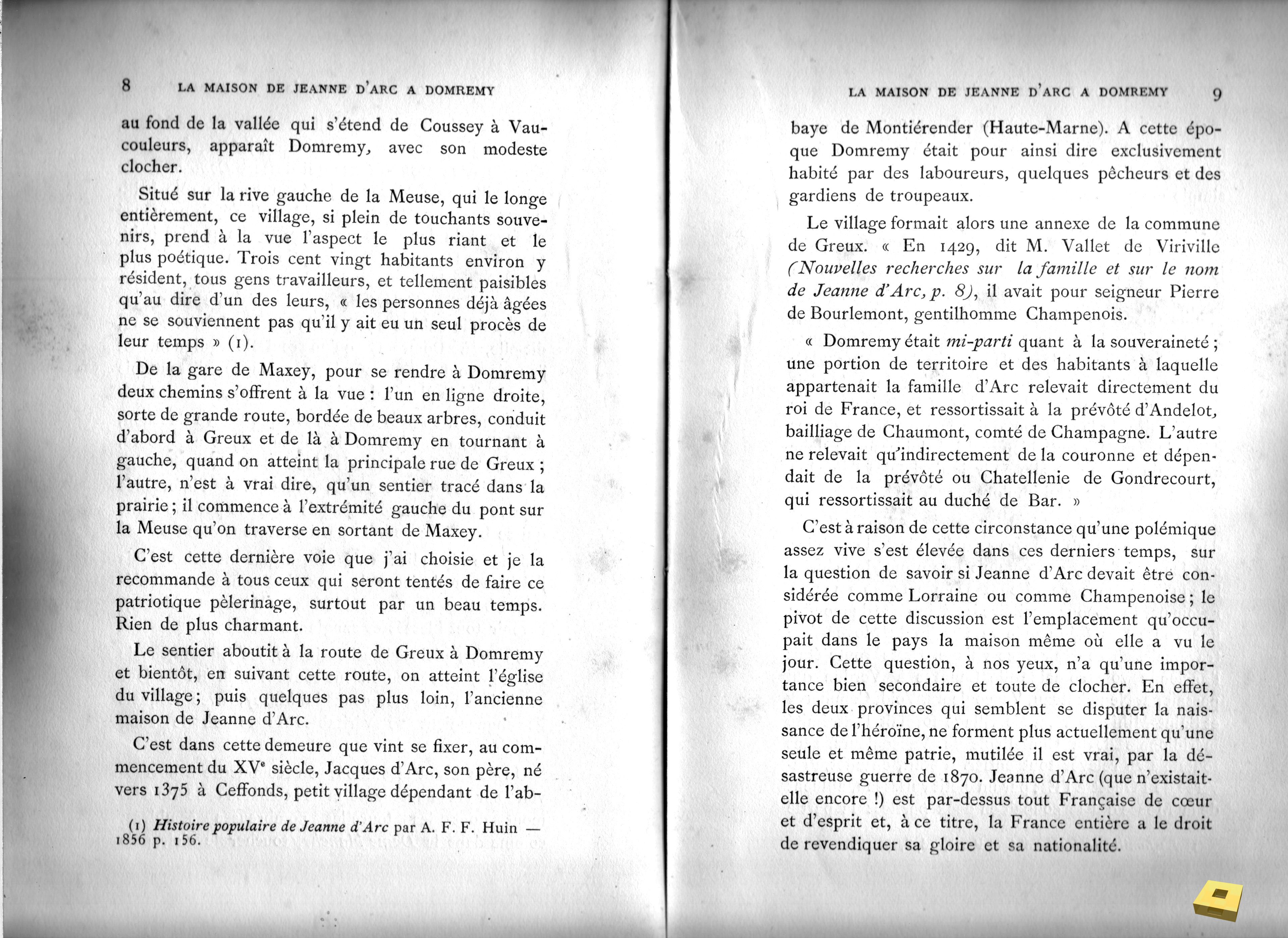
At
the
bottom
of
the
valley
that
extends
from
Coussey
to
Vaucouleurs,
Domremy
appears,
with
its
modest
bell
tower.
Situated
on
the
left
bank
of
the
Meuse,
which
runs
along
it
entirely,
this
village,
so
full
of
touching
memories,
takes
on
the
most
cheerful
and
poetic
aspect.
About
three
hundred
and
twenty
inhabitants
live
there,
all
hard-working
people,
and
so
peaceful
that
according
to
one
of
them,
"the
elderly
do
not
remember
that
there
was
a
single
trial
in
their
time"
(1).
From
Maxey
station,
to
get
to
Domremy,
two
paths
are
available
to
the
view:
one
in
a
straight
line,
a
sort
of
main
road,
lined
with
beautiful
trees,
leads
first
to
Greux
and
from
there
to
Domremy
by
turning
left,
when
you
reach
the
main
street
of
Greux;
the
other,
is
in
truth,
only
a
path
traced
in
the
meadow;
it
begins
at
the
left
end
of
the
bridge
over
the
Meuse
that
you
cross
when
leaving
Maxey.
This
is
the
last
route
that
I
chose
and
I
recommend
it
to
all
those
who
are
tempted
to
make
this
patriotic
pilgrimage,
especially
in
good
weather.
Nothing
more
charming.
The
path
ends
at
the
road
from
Greux
to
Domremy
and
soon,
following
this
road,
you
reach
the
village
church;
then
a
few
steps
further,
the
old
house
of
Joan
of
Arc.
It
is
in
this
residence
that
Jacques
d'Arc,
his
father,
came
to
settle,
at
the
beginning
of
the
15th
century,
born
around
1375
in
Ceffonds,
a
small
village
dependent
on
the
abbey
of
Montiérender
(Haute-Marne).
At
that
time
Domremy
was,
so
to
speak,
exclusively
inhabited
by
ploughmen,
a
few
fishermen
and
herdsmen.
The
village
then
formed
an
annex
of
the
commune
of
Greux.
"In
1429,"
says
M.
Vallet
de
Viriville
(New
research
on
the
family
and
on
the
name
of
Joan
of
Arc,
p.
8),
"its
lord
was
Pierre
de
Bourlemont,
a
gentleman
from
Champagne.
"Domremy
was
half-party
as
to
sovereignty;
a
portion
of
territory
and
inhabitants
to
which
the
d'Arc
family
belonged
came
directly
under
the
king
of
France,
and
fell
under
the
provostship
of
Andelot,
bailiwick
of
Chaumont,
county
of
Champagne.
The
other
came
only
indirectly
under
the
crown
and
depended
on
the
provostship
or
Chatellenie
of
Gondrecourt,
which
fell
under
the
duchy
of
Bar.
»
It
is
because
of
this
circumstance
that
a
fairly
lively
controversy
has
arisen
in
recent
times,
on
the
question
of
whether
Joan
of
Arc
should
be
considered
as
Lorraine
or
as
Champenoise;
the
pivot
of
this
discussion
is
the
location
occupied
in
the
country
by
the
very
house
where
she
was
born.
This
question,
in
our
eyes,
has
only
a
very
secondary
and
parochial
importance.
Indeed,
the
two
provinces
which
seem
to
dispute
the
birth
of
the
heroine,
no
longer
form
at
present
only
one
and
the
same
homeland,
mutilated
it
is
true,
by
the
disastrous
war
of
1870.
Joan
of
Arc
(why
did
she
still
exist!)
is
above
all
French
in
heart
and
mind
and,
as
such,
the
whole
of
France
has
the
right
to
claim
her
glory
and
her
nationality.


