


 Châtenois, church - stained glass window
Click on the image to go full screen.
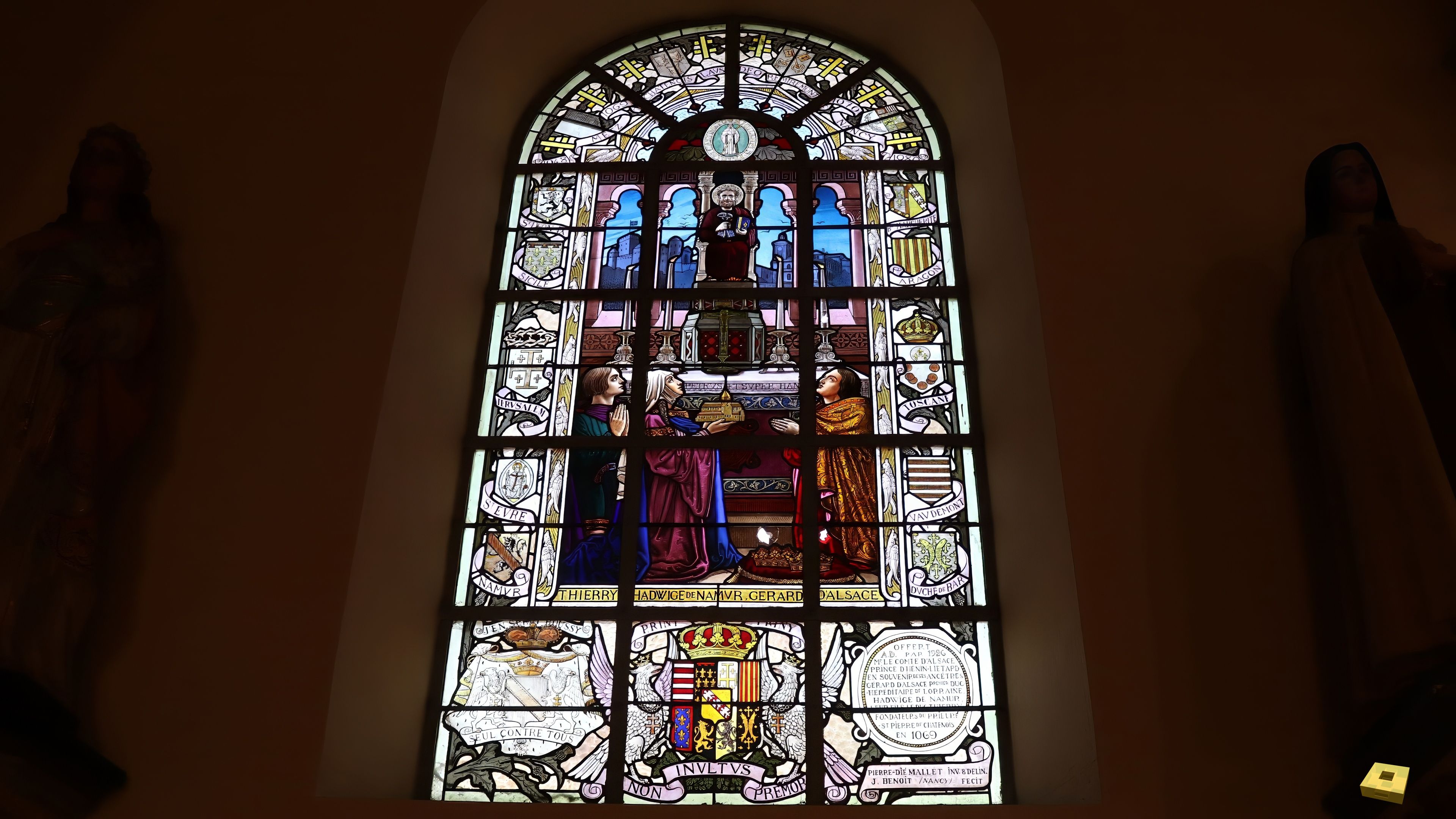
This stained glass window traces the history of Lorraine, of which Châtenois was the capital in 1048. Saint-Pierre can be seen in the center.
This semicircular stained-glass window is richly decorated and rich in history. It is designed by J. Benoit – Nancy, one of the major stained-glass workshops in Lorraine at the turn of the 20th century. It was donated in 1926 by the Prince of Hénin-Liétard, in tribute to the founders of the church of Châtenois. In the center, seated on a Romanesque throne, Saint Peter is depicted holding keys and book. He is surrounded by columns, arcades, and ramparts, evoking the sky and the holy city. Above his head, a medallion depicts Saint Benedict. Below him, three figures kneel: Thierry the son, Hadwige of Namur, his wife, and Gérard of Alsace, a prestigious ancestor, Duke of Lorraine. They present Saint Peter with a reliquary, symbolizing the priory's founding in 1069. At their feet, a royal crown and an ermine mantle affirm their princely rank. Around the scene, in a more heraldic and historical register, appear the coats of arms of the houses of their history (Jerusalem, Aragon, Sicily, Namur, etc.), highlighting the family tree of these great lords. The bottom of the stained-glass window is occupied by a composite coat of arms, accompanied by the motto "Non Inultus Premor" (in a looser, but very common, sense), the battle cry of the Dukes of Lorraine.This semicircular stained-glass window is richly decorated and rich in history. It is designed by J. Benoit – Nancy, one of the major stained-glass workshops in Lorraine at the turn of the 20th century. It was donated in 1926 by the Prince of Hénin-Liétard, in tribute to the founders of the church of Châtenois. In the center, seated on a Romanesque throne, Saint Peter is depicted holding keys and book. He is surrounded by columns, arcades, and ramparts, evoking the sky and the holy city. Above his head, a medallion depicts Saint Benedict. Below him, three figures kneel: Thierry the son, Hadwige of Namur, his wife, and Gérard of Alsace, a prestigious ancestor, Duke of Lorraine. They present Saint Peter with a reliquary, symbolizing the priory's founding in 1069. At their feet, a royal crown and an ermine mantle affirm their princely rank. Around the scene, in a more heraldic and historical register, appear the coats of arms of the houses of their history (Jerusalem, Aragon, Sicily, Namur, etc.), highlighting the family tree of these great lords. The bottom of the stained-glass window is occupied by a composite coat of arms, accompanied by the motto "Non Inultus Premor" (in a looser, but very common, sense), the battle cry of the Dukes of Lorraine.
This semicircular stained-glass window is richly decorated and rich in history. It is designed by J. Benoit – Nancy, one of the major stained-glass workshops in Lorraine at the turn of the 20th century. It was donated in 1926 by the Prince of Hénin-Liétard, in tribute to the founders of the church of Châtenois. In the center, seated on a Romanesque throne, Saint Peter is depicted holding keys and book. He is surrounded by columns, arcades, and ramparts, evoking the sky and the holy city. Above his head, a medallion depicts Saint Benedict. Below him, three figures kneel: Thierry the son, Hadwige of Namur, his wife, and Gérard of Alsace, a prestigious ancestor, Duke of Lorraine. They present Saint Peter with a reliquary, symbolizing the priory's founding in 1069. At their feet, a royal crown and an ermine mantle affirm their princely rank. Around the scene, in a more heraldic and historical register, appear the coats of arms of the houses of their history (Jerusalem, Aragon, Sicily, Namur, etc.), highlighting the family tree of these great lords. The bottom of the stained-glass window is occupied by a composite coat of arms, accompanied by the motto "Non Inultus Premor" (in a looser, but very common, sense), the battle cry of the Dukes of Lorraine.


