


 Sion, N.D. stained glass window
Click on the image to go full screen.
The stained glass window represents Sigebert III, canonized Merovingian king.
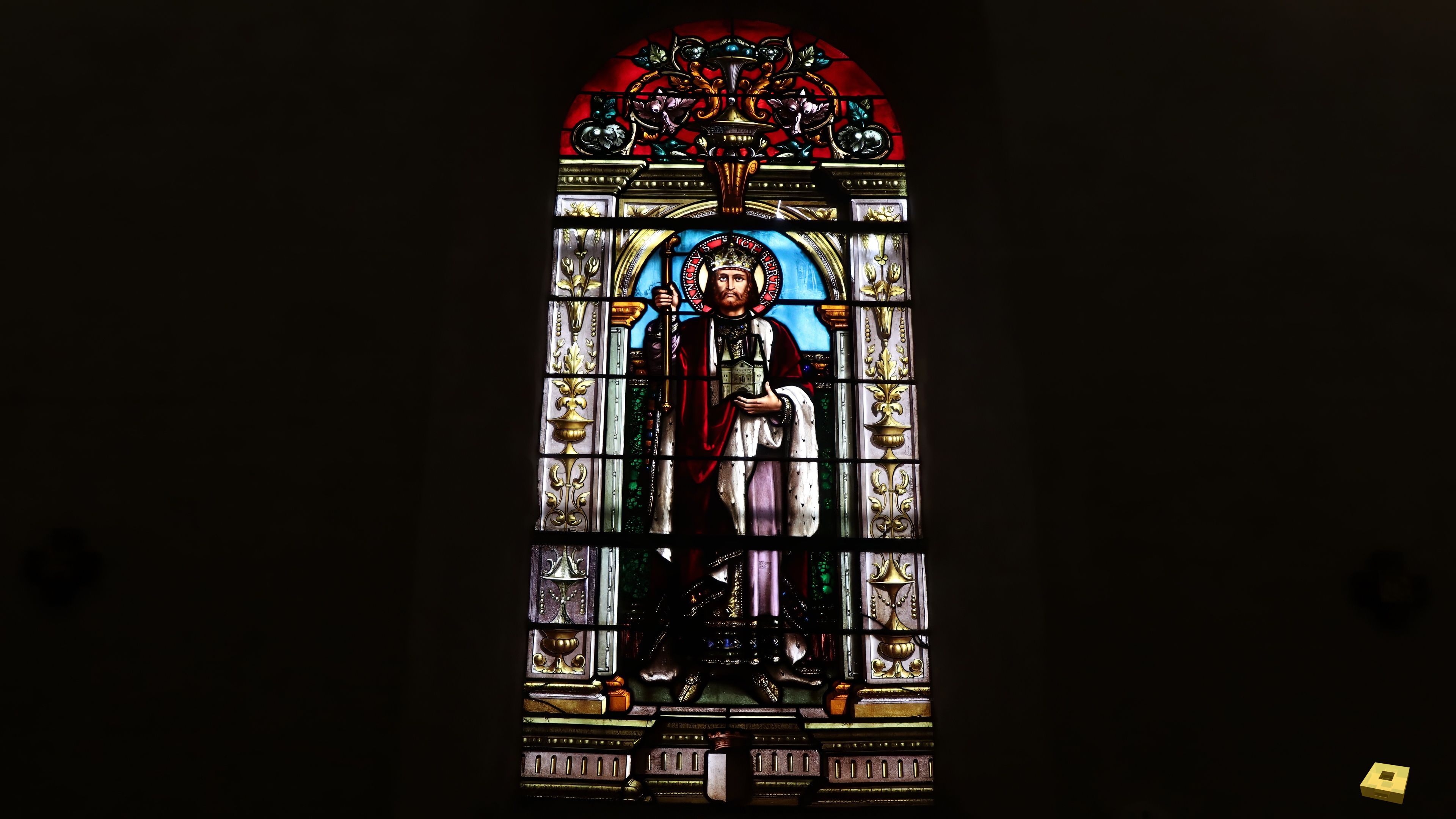
The stained glass window depicts Saint Sigisbert, a canonized Merovingian king. The inscription in his halo, Sanctus Sigebertus, confirms his identification. Saint Sigisbert is depicted standing in majesty, dressed in a long royal mantle edged with ermine, a symbol of purity and nobility. His frontal posture, dignified and serene, denotes his role as a pious king and protector of the Church. He wears a royal crown, an emblem of his temporal authority, which recalls his reign in the 6th century as King of Austrasia, one of the divisions of the Merovingian kingdom. In his right hand, he holds a scepter adorned with a golden pommel, a classic attribute of royalty and legitimate power. In his left hand, he presents a model of a church, a symbol of his contribution to the construction of places of worship and his role as a builder. The halo testifies to his holiness and canonization by the Church. Saint Sigisbert stands in an architectural niche with columns decorated with golden floral motifs and Corinthian capitals. This luxurious frame evokes a solemn and sacred atmosphere. The background shows a bright blue sky, the decoration of which is blurred. At the bottom of the stained glass window, a decorated coat of arms.The stained glass window depicts Saint Sigisbert, a canonized Merovingian king. The inscription in his halo, Sanctus Sigebertus, confirms his identification. Saint Sigisbert is depicted standing in majesty, dressed in a long royal mantle edged with ermine, a symbol of purity and nobility. His frontal posture, dignified and serene, denotes his role as a pious king and protector of the Church. He wears a royal crown, an emblem of his temporal authority, which recalls his reign in the 6th century as King of Austrasia, one of the divisions of the Merovingian kingdom. In his right hand, he holds a scepter adorned with a golden pommel, a classic attribute of royalty and legitimate power. In his left hand, he presents a model of a church, a symbol of his contribution to the construction of places of worship and his role as a builder. The halo testifies to his holiness and canonization by the Church. Saint Sigisbert stands in an architectural niche with columns decorated with golden floral motifs and Corinthian capitals. This luxurious frame evokes a solemn and sacred atmosphere. The background shows a bright blue sky, the decoration of which is blurred. At the bottom of the stained glass window, a decorated coat of arms.
The stained glass window depicts Saint Sigisbert, a canonized Merovingian king. The inscription in his halo, Sanctus Sigebertus, confirms his identification. Saint Sigisbert is depicted standing in majesty, dressed in a long royal mantle edged with ermine, a symbol of purity and nobility. His frontal posture, dignified and serene, denotes his role as a pious king and protector of the Church. He wears a royal crown, an emblem of his temporal authority, which recalls his reign in the 6th century as King of Austrasia, one of the divisions of the Merovingian kingdom. In his right hand, he holds a scepter adorned with a golden pommel, a classic attribute of royalty and legitimate power. In his left hand, he presents a model of a church, a symbol of his contribution to the construction of places of worship and his role as a builder. The halo testifies to his holiness and canonization by the Church. Saint Sigisbert stands in an architectural niche with columns decorated with golden floral motifs and Corinthian capitals. This luxurious frame evokes a solemn and sacred atmosphere. The background shows a bright blue sky, the decoration of which is blurred. At the bottom of the stained glass window, a decorated coat of arms.