


 Liffol, church - stained glass
Click on the image to go full screen.
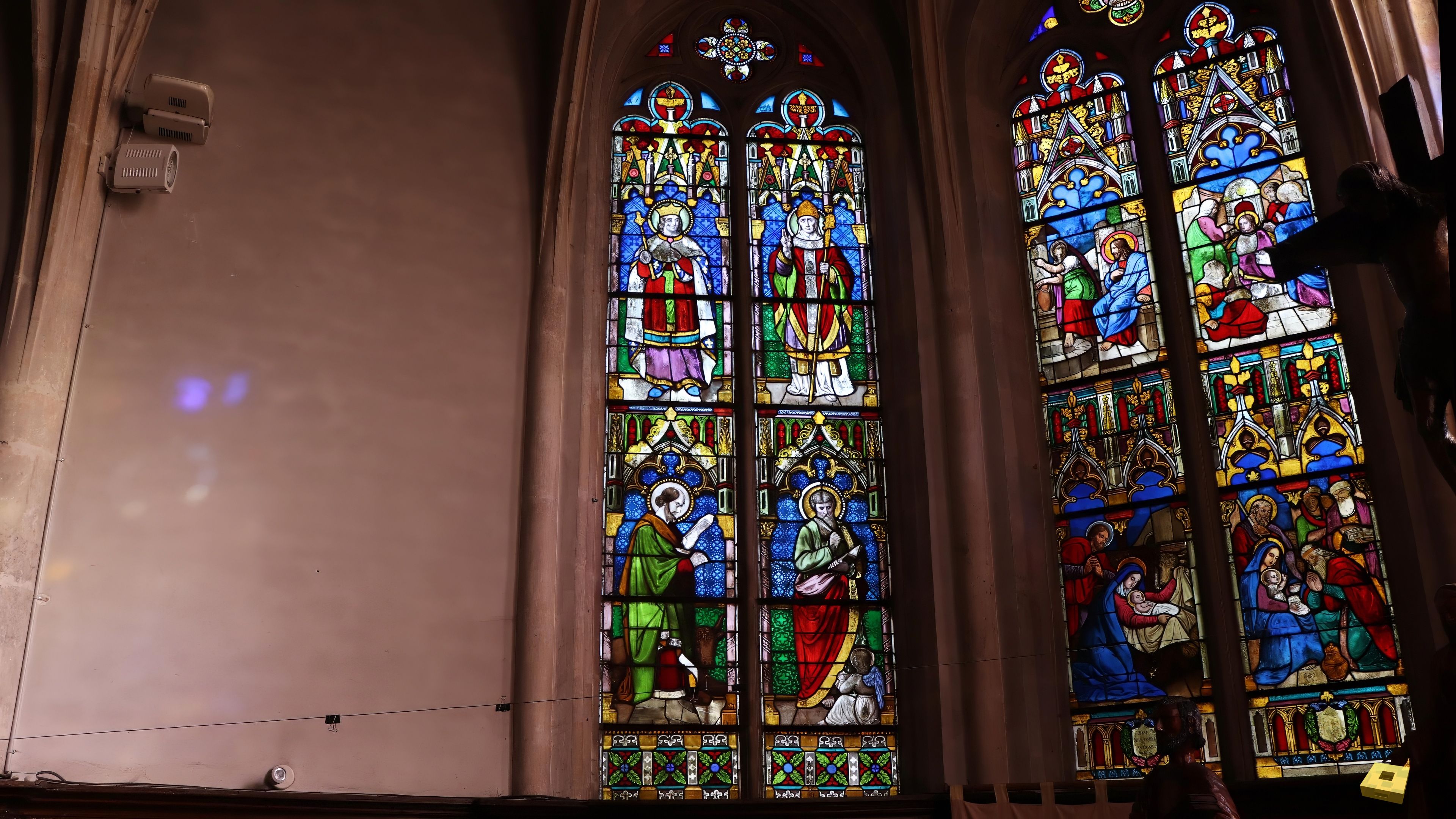
This monumental stained glass window in two lancets presents four figures from left to right and from top to bottom, Saint-Louis, Saint-Luc, Saint-Vincent and Saint Matthew.
This monumental stained glass window in two lancets presents four figures from the Christian tradition and integrates neo-Gothic architectural elements, such as niches and pointed arches. The figures represented are richly dressed and surrounded by finely worked floral and geometric decorations. Each of the figures is identified by their symbolic attributes and their religious role. For the left lancet, at the top, a crowned saint king, is most likely Saint Louis of France. He is dressed in purple and blue, carrying an ornate scepter and a royal crown. At the bottom, Saint Luke, is identifiable by the presence of an ox at his side. He is represented holding a parchment or a manuscript. For the right lancet, at the top, a saint bishop, holding a crozier and blessing, is identified as probably Saint Vincent, the patron saint of the church. He is dressed in the liturgical vestments of a bishop. Below, Saint Matthew, depicted with a book and a haloed winged angel, symbol of his Gospel. His appearance as a bearded sage expresses his role as a witness to the first accounts of the life of Christ. The decorated niches and foliage motifs are characteristic of neo-Gothic architecture, popularized in the 19th century. The quatrefoil at the top is decorated with a cross surrounded by floral motifs, symbolizing the centrality of the Christian faith.This monumental stained glass window in two lancets presents four figures from the Christian tradition and integrates neo-Gothic architectural elements, such as niches and pointed arches. The figures represented are richly dressed and surrounded by finely worked floral and geometric decorations. Each of the figures is identified by their symbolic attributes and their religious role. For the left lancet, at the top, a crowned saint king, is most likely Saint Louis of France. He is dressed in purple and blue, carrying an ornate scepter and a royal crown. At the bottom, Saint Luke, is identifiable by the presence of an ox at his side. He is represented holding a parchment or a manuscript. For the right lancet, at the top, a saint bishop, holding a crozier and blessing, is identified as probably Saint Vincent, the patron saint of the church. He is dressed in the liturgical vestments of a bishop. Below, Saint Matthew, depicted with a book and a haloed winged angel, symbol of his Gospel. His appearance as a bearded sage expresses his role as a witness to the first accounts of the life of Christ. The decorated niches and foliage motifs are characteristic of neo-Gothic architecture, popularized in the 19th century. The quatrefoil at the top is decorated with a cross surrounded by floral motifs, symbolizing the centrality of the Christian faith.
This monumental stained glass window in two lancets presents four figures from the Christian tradition and integrates neo-Gothic architectural elements, such as niches and pointed arches. The figures represented are richly dressed and surrounded by finely worked floral and geometric decorations. Each of the figures is identified by their symbolic attributes and their religious role. For the left lancet, at the top, a crowned saint king, is most likely Saint Louis of France. He is dressed in purple and blue, carrying an ornate scepter and a royal crown. At the bottom, Saint Luke, is identifiable by the presence of an ox at his side. He is represented holding a parchment or a manuscript. For the right lancet, at the top, a saint bishop, holding a crozier and blessing, is identified as probably Saint Vincent, the patron saint of the church. He is dressed in the liturgical vestments of a bishop. Below, Saint Matthew, depicted with a book and a haloed winged angel, symbol of his Gospel. His appearance as a bearded sage expresses his role as a witness to the first accounts of the life of Christ. The decorated niches and foliage motifs are characteristic of neo-Gothic architecture, popularized in the 19th century. The quatrefoil at the top is decorated with a cross surrounded by floral motifs, symbolizing the centrality of the Christian faith.

