


 Sion, N.D. stained glass window
Click on the image to go full screen.
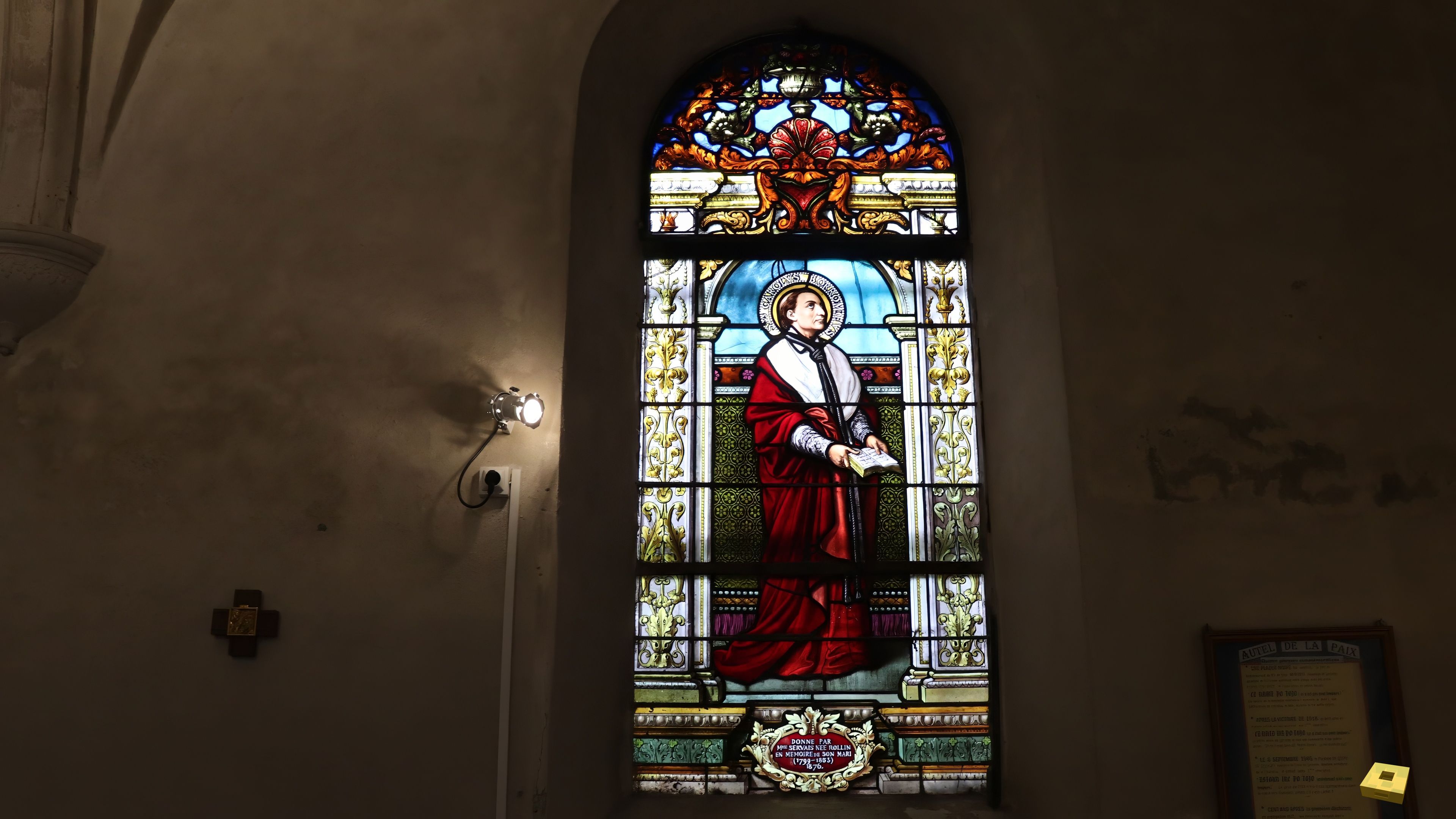
This stained glass window represents Saint Charles Borromeo and was offered by Mrs. Servais, née Rollin, in memory of her husband.
This stained glass window depicts Saint Charles Borromeo, a major figure of the Catholic Reformation and the Counter-Reformation. The Latin inscription in his halo, Carolus Borromeus, confirms the identity. Saint Charles is here depicted in a posture of devotion and humility. Iconographic Analysis The rope tied around the neck symbolizes penance and humility. Saint Charles frequently wore this symbol, especially in public, to demonstrate his compassion for the poor and sinners. The tonsure is a sign of religious consecration. It reinforces the idea of renunciation of the material world and devotion to God. The open book refers to his active role in implementing the decrees of the Council of Trent, particularly in matters of clergy reform and catechism. The saint is dressed in the red mozetta, a short cape worn by cardinals, and the cassock. His hands hold a book, indicating his intellectual and spiritual vocation. His gaze turned towards the sky evokes a contemplative posture, emphasizing his direct relationship with the divine. Richly decorated columns frame the figure of the saint and evoke classical architecture. The floral decoration and golden motifs emphasize holiness and divine glory. The text specifies that the stained glass window was donated in 1876 by Madame Servais née Rollin, in memory of her husband. This detail underlines the importance of private devotions in the commissioning and financing of religious art in the 19th century.This stained glass window depicts Saint Charles Borromeo, a major figure of the Catholic Reformation and the Counter-Reformation. The Latin inscription in his halo, Carolus Borromeus, confirms the identity. Saint Charles is here depicted in a posture of devotion and humility. Iconographic Analysis The rope tied around the neck symbolizes penance and humility. Saint Charles frequently wore this symbol, especially in public, to demonstrate his compassion for the poor and sinners. The tonsure is a sign of religious consecration. It reinforces the idea of renunciation of the material world and devotion to God. The open book refers to his active role in implementing the decrees of the Council of Trent, particularly in matters of clergy reform and catechism. The saint is dressed in the red mozetta, a short cape worn by cardinals, and the cassock. His hands hold a book, indicating his intellectual and spiritual vocation. His gaze turned towards the sky evokes a contemplative posture, emphasizing his direct relationship with the divine. Richly decorated columns frame the figure of the saint and evoke classical architecture. The floral decoration and golden motifs emphasize holiness and divine glory. The text specifies that the stained glass window was donated in 1876 by Madame Servais née Rollin, in memory of her husband. This detail underlines the importance of private devotions in the commissioning and financing of religious art in the 19th century.
This stained glass window depicts Saint Charles Borromeo, a major figure of the Catholic Reformation and the Counter-Reformation. The Latin inscription in his halo, Carolus Borromeus, confirms the identity. Saint Charles is here depicted in a posture of devotion and humility. Iconographic Analysis The rope tied around the neck symbolizes penance and humility. Saint Charles frequently wore this symbol, especially in public, to demonstrate his compassion for the poor and sinners. The tonsure is a sign of religious consecration. It reinforces the idea of renunciation of the material world and devotion to God. The open book refers to his active role in implementing the decrees of the Council of Trent, particularly in matters of clergy reform and catechism. The saint is dressed in the red mozetta, a short cape worn by cardinals, and the cassock. His hands hold a book, indicating his intellectual and spiritual vocation. His gaze turned towards the sky evokes a contemplative posture, emphasizing his direct relationship with the divine. Richly decorated columns frame the figure of the saint and evoke classical architecture. The floral decoration and golden motifs emphasize holiness and divine glory. The text specifies that the stained glass window was donated in 1876 by Madame Servais née Rollin, in memory of her husband. This detail underlines the importance of private devotions in the commissioning and financing of religious art in the 19th century.


