


 Rouvres, church - stained glass window
Click on the image to go full screen.
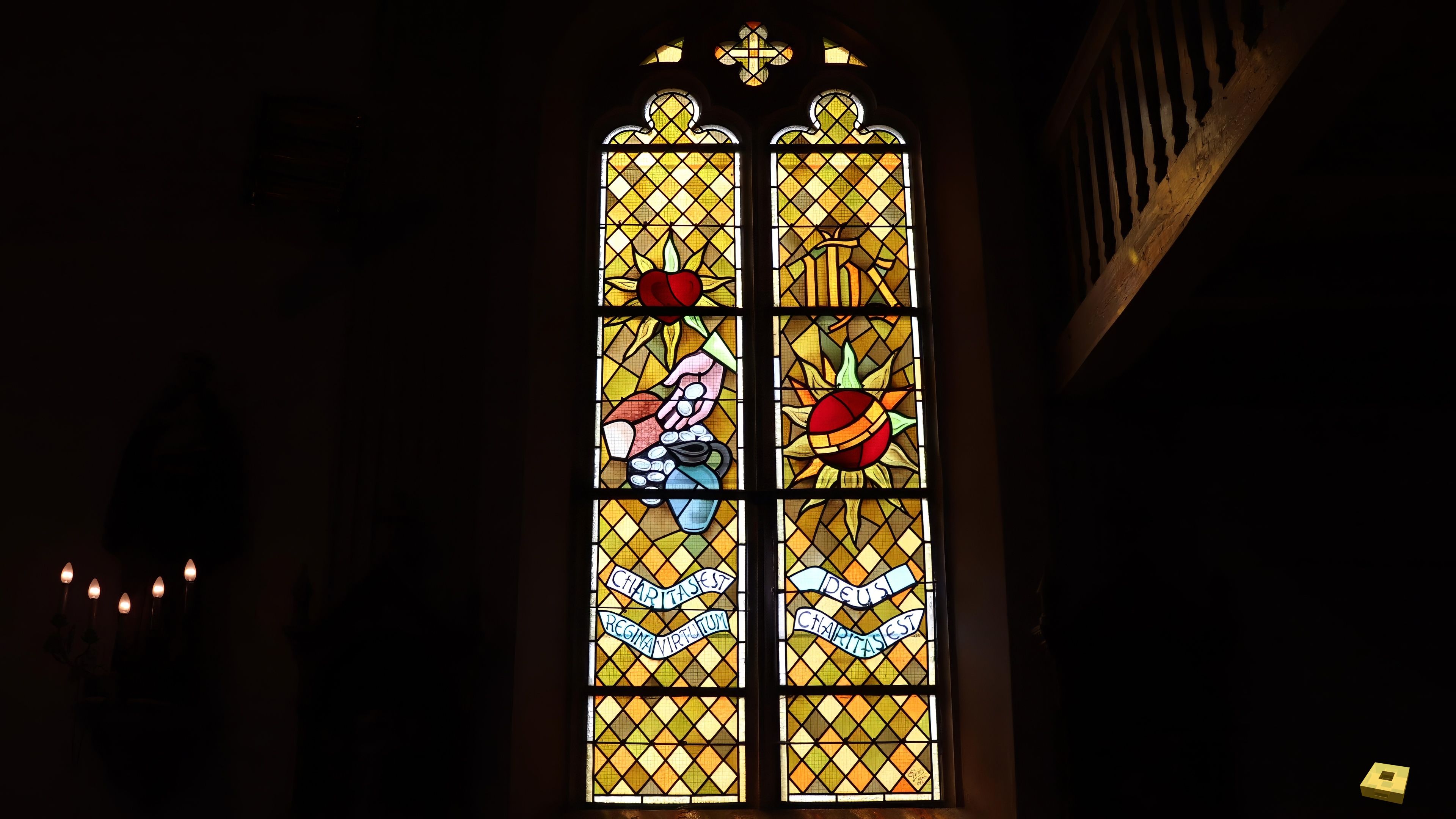
This double-arched stained glass window represents an allegory of charity: Charitas est regina virtutum, Deus charitas est.
This stained glass window is composed of two main lancets, surmounted by a quadrilobed tympanum with a simple geometric pattern. Its construction is based on a yellow and gold grid background, which diffuses a warm and unified light. On the left, an outstretched hand pours coins between the bread and the pitcher. This gesture is surmounted by a red flaming heart surrounded by yellow rays, evoking charity. On the right, in symmetry with the heart of the left lancet, we can see the letters IHS "Iesus Hominum Salvator" Jesus Savior of Humanity. Below a red circle surrounded by yellow rays At the bottom of each lancet, banners called phylacteries bear Latin inscriptions: on the left, "Charitas est regina virtutum" (Charity is the queen of virtues). on the right, "Deus charitas est" (God is love). The upper tympanum is decorated with a crossed geometric pattern. The stained glass adopts a color palette dominated by warm tones (yellow, gold, red) and some cold accents (blue, green). This contrast highlights the central elements, such as the hearts and symbolic gestures. The whole is based on a symmetry between the two lancets: the red heart (left) finds its echo in the letters IHS (right), visually and thematically balancing the message.This stained glass window is composed of two main lancets, surmounted by a quadrilobed tympanum with a simple geometric pattern. Its construction is based on a yellow and gold grid background, which diffuses a warm and unified light. On the left, an outstretched hand pours coins between the bread and the pitcher. This gesture is surmounted by a red flaming heart surrounded by yellow rays, evoking charity. On the right, in symmetry with the heart of the left lancet, we can see the letters IHS "Iesus Hominum Salvator" Jesus Savior of Humanity. Below a red circle surrounded by yellow rays At the bottom of each lancet, banners called phylacteries bear Latin inscriptions: on the left, "Charitas est regina virtutum" (Charity is the queen of virtues). on the right, "Deus charitas est" (God is love). The upper tympanum is decorated with a crossed geometric pattern. The stained glass adopts a color palette dominated by warm tones (yellow, gold, red) and some cold accents (blue, green). This contrast highlights the central elements, such as the hearts and symbolic gestures. The whole is based on a symmetry between the two lancets: the red heart (left) finds its echo in the letters IHS (right), visually and thematically balancing the message.
This stained glass window is composed of two main lancets, surmounted by a quadrilobed tympanum with a simple geometric pattern. Its construction is based on a yellow and gold grid background, which diffuses a warm and unified light. On the left, an outstretched hand pours coins between the bread and the pitcher. This gesture is surmounted by a red flaming heart surrounded by yellow rays, evoking charity. On the right, in symmetry with the heart of the left lancet, we can see the letters IHS "Iesus Hominum Salvator" Jesus Savior of Humanity. Below a red circle surrounded by yellow rays At the bottom of each lancet, banners called phylacteries bear Latin inscriptions: on the left, "Charitas est regina virtutum" (Charity is the queen of virtues). on the right, "Deus charitas est" (God is love). The upper tympanum is decorated with a crossed geometric pattern. The stained glass adopts a color palette dominated by warm tones (yellow, gold, red) and some cold accents (blue, green). This contrast highlights the central elements, such as the hearts and symbolic gestures. The whole is based on a symmetry between the two lancets: the red heart (left) finds its echo in the letters IHS (right), visually and thematically balancing the message.


