


 Bulgnéville, church - stained glass window
Click on the image to go full screen.
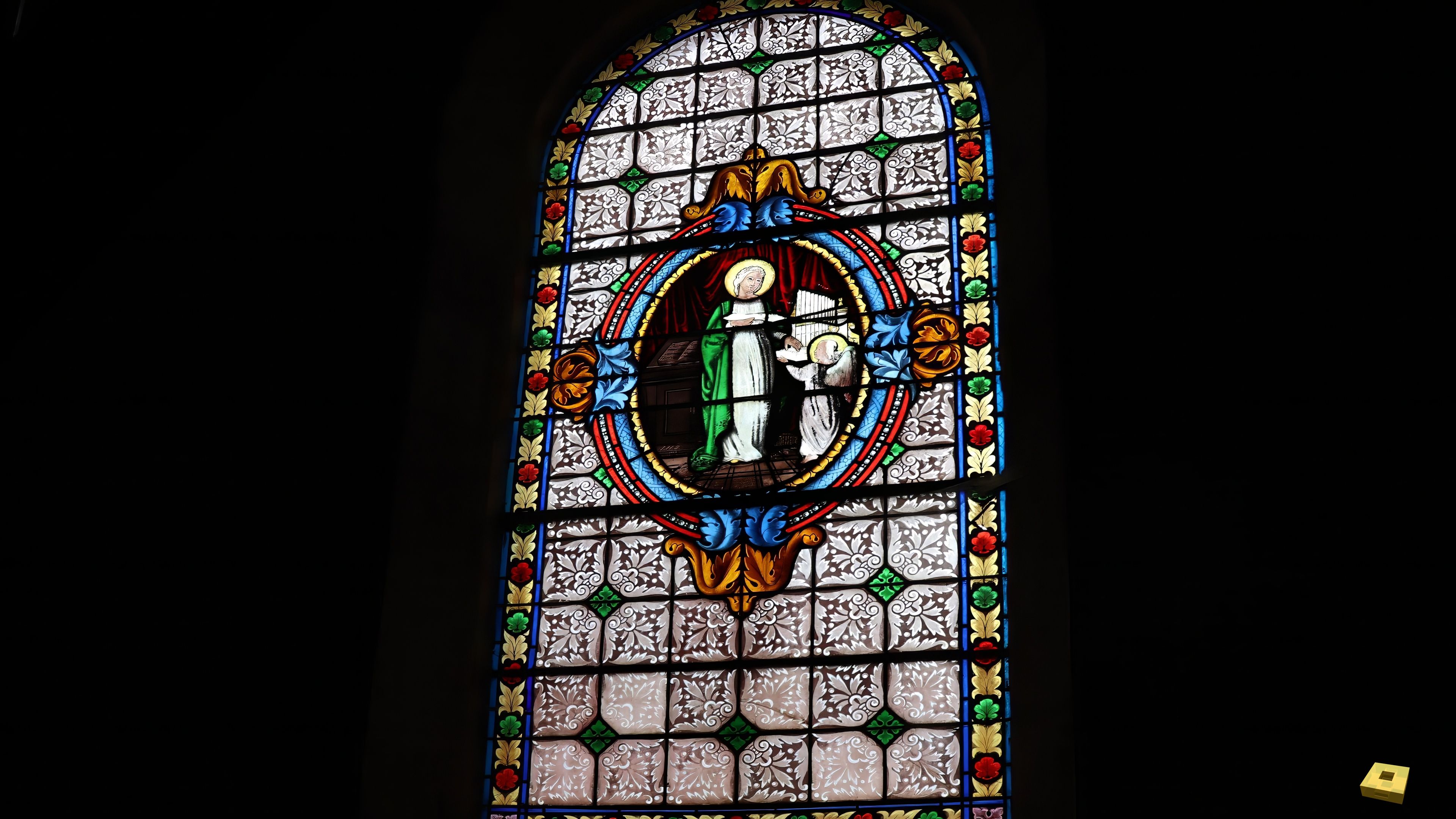
This stained glass window represents Saint Cecilia with her portable organ.
This vertical stained-glass window, set into a round-arched bay, is organized around a central oval medallion framed by neo-Gothic decorative motifs such as acanthus leaves, volutes, and arabesques in tones of blue, red, gold, and green. This frame is set against a grisaille background adorned with vegetal scrollwork, creating a contrast between the abstract decoration and the central scene. At the center, a haloed saint, a young woman with fair hair, stands in an interior space marked by a checkered floor and, in the background, a red curtain. With one hand, she plays a portative organ held by an angel, also haloed. In her other hand, she holds a sheet of music. To her left (on our right), resting on a stand, we can glimpse an open antiphonary. All these elements clearly identify Saint Cecilia, a Roman virgin of the 3rd century and the patron saint of musicians. By its style and aesthetic choices, this stained-glass window belongs to the neo-Gothic movement of the late 19th century, a period marked by the restoration and embellishment of religious heritage.This vertical stained-glass window, set into a round-arched bay, is organized around a central oval medallion framed by neo-Gothic decorative motifs such as acanthus leaves, volutes, and arabesques in tones of blue, red, gold, and green. This frame is set against a grisaille background adorned with vegetal scrollwork, creating a contrast between the abstract decoration and the central scene. At the center, a haloed saint, a young woman with fair hair, stands in an interior space marked by a checkered floor and, in the background, a red curtain. With one hand, she plays a portative organ held by an angel, also haloed. In her other hand, she holds a sheet of music. To her left (on our right), resting on a stand, we can glimpse an open antiphonary. All these elements clearly identify Saint Cecilia, a Roman virgin of the 3rd century and the patron saint of musicians. By its style and aesthetic choices, this stained-glass window belongs to the neo-Gothic movement of the late 19th century, a period marked by the restoration and embellishment of religious heritage.
This vertical stained-glass window, set into a round-arched bay, is organized around a central oval medallion framed by neo-Gothic decorative motifs such as acanthus leaves, volutes, and arabesques in tones of blue, red, gold, and green. This frame is set against a grisaille background adorned with vegetal scrollwork, creating a contrast between the abstract decoration and the central scene. At the center, a haloed saint, a young woman with fair hair, stands in an interior space marked by a checkered floor and, in the background, a red curtain. With one hand, she plays a portative organ held by an angel, also haloed. In her other hand, she holds a sheet of music. To her left (on our right), resting on a stand, we can glimpse an open antiphonary. All these elements clearly identify Saint Cecilia, a Roman virgin of the 3rd century and the patron saint of musicians. By its style and aesthetic choices, this stained-glass window belongs to the neo-Gothic movement of the late 19th century, a period marked by the restoration and embellishment of religious heritage.


