


 Viocourt, church - stained glass
Click on the image to go full screen.
This stained glass window represents the scene of the Crucifixion of Jesus Christ.
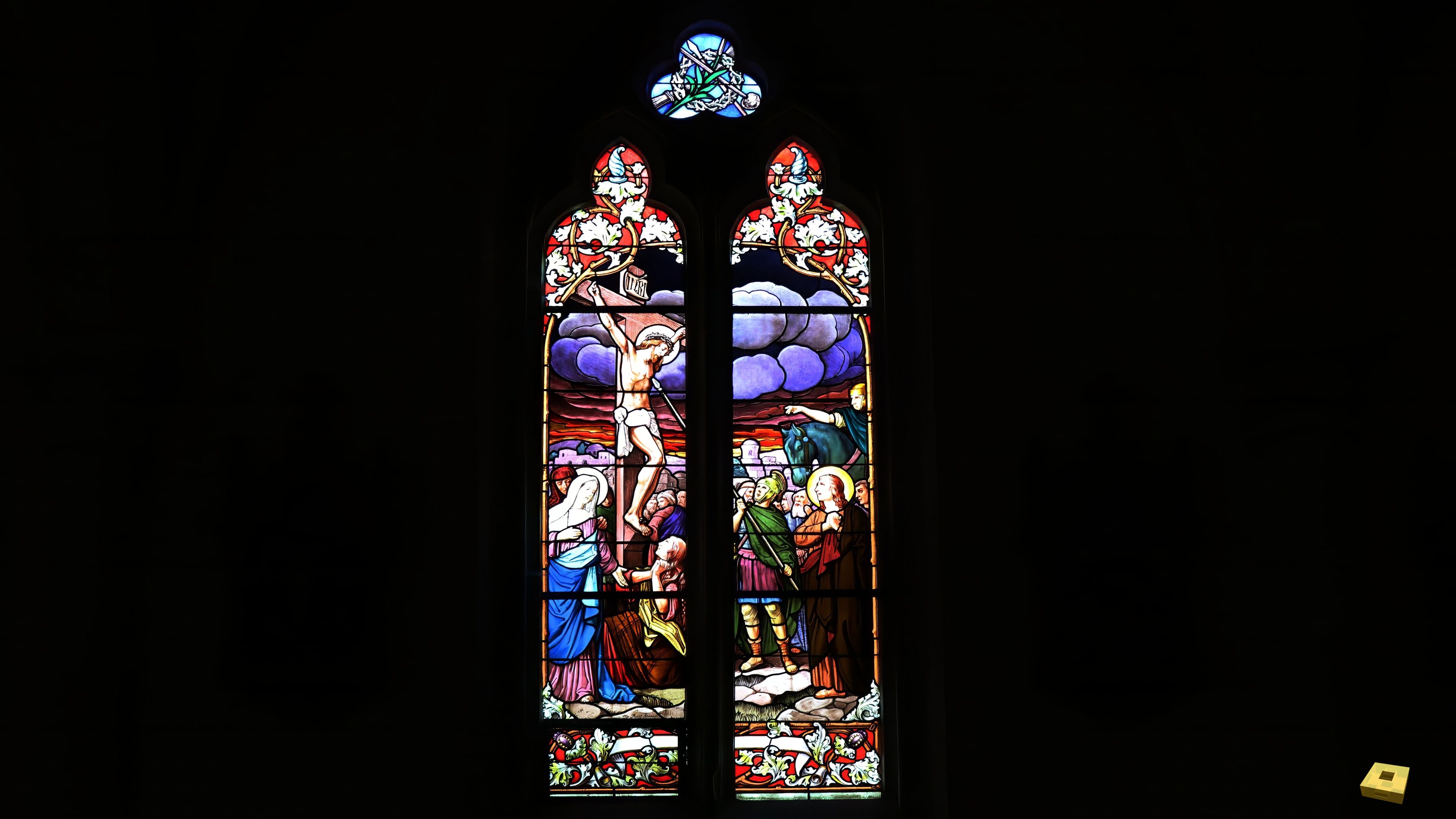
This stained glass window from the Church of Saint-Denis depicts the scene of the Crucifixion of Jesus Christ. In the left panel, Jesus is crucified in the center of the scene, nailed to the cross with the inscription "INRI" (Iesus Nazarenus Rex Iudaeorum, "Jesus of Nazareth, King of the Jews") above him. To the left of Jesus is a woman in blue and white robes, who is likely Mary, his mother. She is depicted in a posture of mourning and pain, watching her son on the cross. Mary is a central character in this scene, as she is often depicted as silently suffering alongside Jesus. The kneeling woman with her hands in prayer and her gaze turned toward Jesus is likely Mary Magdalene. She is often depicted at the foot of the cross, in a posture of supplication or intense devotion. On the right panel, we can see a young man with a halo, it could be Saint John the Evangelist, one of the apostles closest to Jesus. John is often represented next to Mary in the scenes of the Crucifixion, because it is to him that Jesus entrusts his mother. Several soldiers are visible in the scene, one of them on horseback, directing the operations. The other with a lance that pierces Jesus' side. These soldiers are represented to show the context of the crucifixion by the Roman authorities. In the background and around the scene, several characters are gathered, representing the witnesses of the crucifixion, some of whom show expressions of sadness or astonishment.This stained glass window from the Church of Saint-Denis depicts the scene of the Crucifixion of Jesus Christ. In the left panel, Jesus is crucified in the center of the scene, nailed to the cross with the inscription "INRI" (Iesus Nazarenus Rex Iudaeorum, "Jesus of Nazareth, King of the Jews") above him. To the left of Jesus is a woman in blue and white robes, who is likely Mary, his mother. She is depicted in a posture of mourning and pain, watching her son on the cross. Mary is a central character in this scene, as she is often depicted as silently suffering alongside Jesus. The kneeling woman with her hands in prayer and her gaze turned toward Jesus is likely Mary Magdalene. She is often depicted at the foot of the cross, in a posture of supplication or intense devotion. On the right panel, we can see a young man with a halo, it could be Saint John the Evangelist, one of the apostles closest to Jesus. John is often represented next to Mary in the scenes of the Crucifixion, because it is to him that Jesus entrusts his mother. Several soldiers are visible in the scene, one of them on horseback, directing the operations. The other with a lance that pierces Jesus' side. These soldiers are represented to show the context of the crucifixion by the Roman authorities. In the background and around the scene, several characters are gathered, representing the witnesses of the crucifixion, some of whom show expressions of sadness or astonishment.
This stained glass window from the Church of Saint-Denis depicts the scene of the Crucifixion of Jesus Christ. In the left panel, Jesus is crucified in the center of the scene, nailed to the cross with the inscription "INRI" (Iesus Nazarenus Rex Iudaeorum, "Jesus of Nazareth, King of the Jews") above him. To the left of Jesus is a woman in blue and white robes, who is likely Mary, his mother. She is depicted in a posture of mourning and pain, watching her son on the cross. Mary is a central character in this scene, as she is often depicted as silently suffering alongside Jesus. The kneeling woman with her hands in prayer and her gaze turned toward Jesus is likely Mary Magdalene. She is often depicted at the foot of the cross, in a posture of supplication or intense devotion. On the right panel, we can see a young man with a halo, it could be Saint John the Evangelist, one of the apostles closest to Jesus. John is often represented next to Mary in the scenes of the Crucifixion, because it is to him that Jesus entrusts his mother. Several soldiers are visible in the scene, one of them on horseback, directing the operations. The other with a lance that pierces Jesus' side. These soldiers are represented to show the context of the crucifixion by the Roman authorities. In the background and around the scene, several characters are gathered, representing the witnesses of the crucifixion, some of whom show expressions of sadness or astonishment.


