


 Viocourt, church - stained glass
Click on the image to go full screen.
Saint-Denis Church
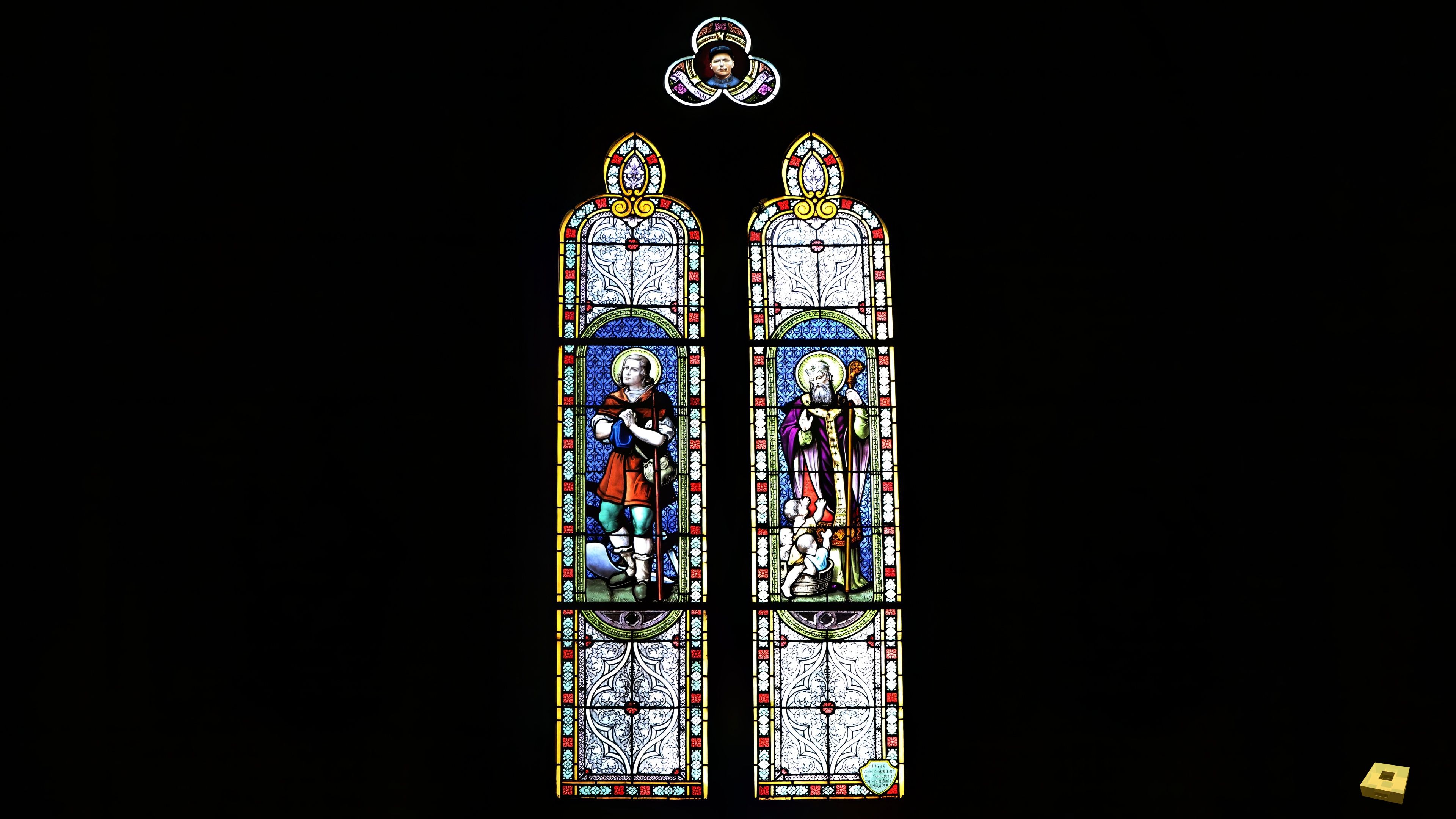
On this stained glass window the two characters represented are most probably Saint-Jacques on the left and Saint-Nicolas on the right.
In this stained glass window, the two characters represented are most likely Saint James and Saint Nicholas, two figures often associated with protection and miracles. The character on the left is in pilgrim's attire, with a walking stick and a satchel, these are the typical attributes of Saint James the Greater. Although the scallop shell is not present, the pilgrim's clothing and the stick remain strong clues to identify Saint James. He is the patron saint of pilgrims, especially those on the way to Compostela. The character on the right is in bishop's attire with a crozier. He is most likely Saint Nicholas, recognizable by his beard, his mitre, and the episcopal crozier. The presence of the three children in a tub at his feet is an iconographic attribute specific to Saint Nicholas. This image refers to the legend where he is said to have saved three children from the butcher. Saint Nicholas is a very popular saint, known for his generosity and his many miracles. He is the protector of children, travelers and sailors. In summary, this stained glass window represents Saint James the Greater on the left and Saint Nicholas on the right, each with distinctive iconographic attributes that allow them to be easily identified and recall their respective roles in the protection of the faithful.In this stained glass window, the two characters represented are most likely Saint James and Saint Nicholas, two figures often associated with protection and miracles. The character on the left is in pilgrim's attire, with a walking stick and a satchel, these are the typical attributes of Saint James the Greater. Although the scallop shell is not present, the pilgrim's clothing and the stick remain strong clues to identify Saint James. He is the patron saint of pilgrims, especially those on the way to Compostela. The character on the right is in bishop's attire with a crozier. He is most likely Saint Nicholas, recognizable by his beard, his mitre, and the episcopal crozier. The presence of the three children in a tub at his feet is an iconographic attribute specific to Saint Nicholas. This image refers to the legend where he is said to have saved three children from the butcher. Saint Nicholas is a very popular saint, known for his generosity and his many miracles. He is the protector of children, travelers and sailors. In summary, this stained glass window represents Saint James the Greater on the left and Saint Nicholas on the right, each with distinctive iconographic attributes that allow them to be easily identified and recall their respective roles in the protection of the faithful.
In this stained glass window, the two characters represented are most likely Saint James and Saint Nicholas, two figures often associated with protection and miracles. The character on the left is in pilgrim's attire, with a walking stick and a satchel, these are the typical attributes of Saint James the Greater. Although the scallop shell is not present, the pilgrim's clothing and the stick remain strong clues to identify Saint James. He is the patron saint of pilgrims, especially those on the way to Compostela. The character on the right is in bishop's attire with a crozier. He is most likely Saint Nicholas, recognizable by his beard, his mitre, and the episcopal crozier. The presence of the three children in a tub at his feet is an iconographic attribute specific to Saint Nicholas. This image refers to the legend where he is said to have saved three children from the butcher. Saint Nicholas is a very popular saint, known for his generosity and his many miracles. He is the protector of children, travelers and sailors. In summary, this stained glass window represents Saint James the Greater on the left and Saint Nicholas on the right, each with distinctive iconographic attributes that allow them to be easily identified and recall their respective roles in the protection of the faithful.


