


 Pargny, church - stained glass window
Click on the image to go full screen.
This round stained glass window, which decorates the rose window of the church, represents an important theological scene: the Holy Trinity.
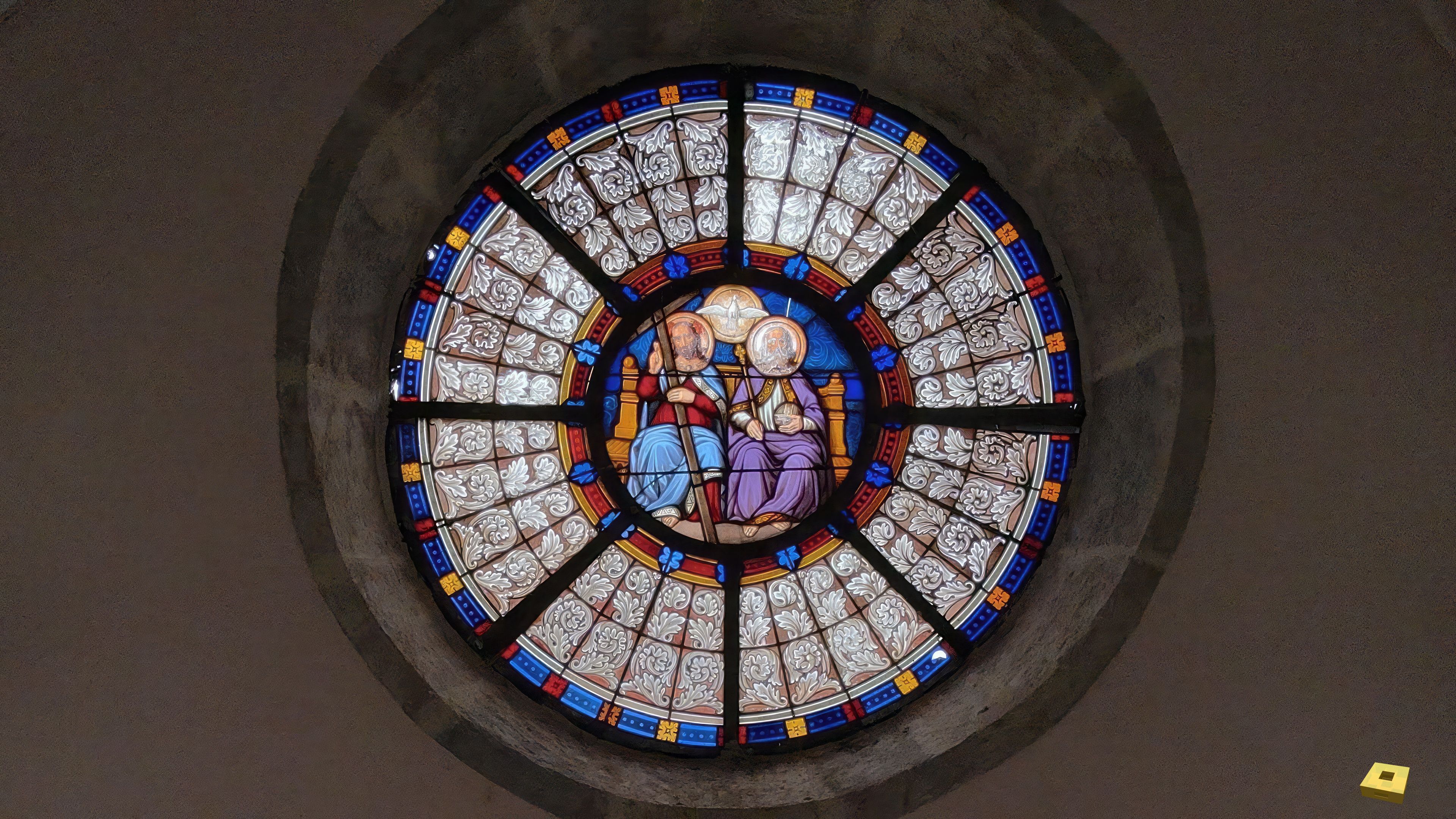
This circular stained glass window, adorning the rose window, represents a major theological scene: the Holy Trinity. The composition places God the Father and God the Son seated on a throne, while the Holy Spirit is depicted in the form of a dove at the top of the scene. Depicted on the right, the Father is dressed in purple pontifical vestments, symbols of his majesty and divine authority. He holds a terrestrial globe, symbol of his universal sovereignty. Placed on the left, the son is dressed in red (symbol of his sacrifice) and blue (representing his divine nature). He holds a cross, recalling his crucifixion and the redemption of humanity. Above the two figures, the dove radiates a golden light, representing the divine force and the unity of the Trinity. The border of the window is richly decorated with white plant and floral motifs, associated with geometric interlacing in blue and red, in a harmonious structure. This stained glass window is a beautiful example of religious glass art from the 19th century or early 20th century, the figures of God the Father and God the Son are arranged in balance, symbolizing unity and equality within the Trinity. The use of gold, red, blue and purple hues brings a soft and divine light to the whole. The circular format evokes perfection and eternity, concepts closely linked to Christian theology.This circular stained glass window, adorning the rose window, represents a major theological scene: the Holy Trinity. The composition places God the Father and God the Son seated on a throne, while the Holy Spirit is depicted in the form of a dove at the top of the scene. Depicted on the right, the Father is dressed in purple pontifical vestments, symbols of his majesty and divine authority. He holds a terrestrial globe, symbol of his universal sovereignty. Placed on the left, the son is dressed in red (symbol of his sacrifice) and blue (representing his divine nature). He holds a cross, recalling his crucifixion and the redemption of humanity. Above the two figures, the dove radiates a golden light, representing the divine force and the unity of the Trinity. The border of the window is richly decorated with white plant and floral motifs, associated with geometric interlacing in blue and red, in a harmonious structure. This stained glass window is a beautiful example of religious glass art from the 19th century or early 20th century, the figures of God the Father and God the Son are arranged in balance, symbolizing unity and equality within the Trinity. The use of gold, red, blue and purple hues brings a soft and divine light to the whole. The circular format evokes perfection and eternity, concepts closely linked to Christian theology.
This circular stained glass window, adorning the rose window, represents a major theological scene: the Holy Trinity. The composition places God the Father and God the Son seated on a throne, while the Holy Spirit is depicted in the form of a dove at the top of the scene. Depicted on the right, the Father is dressed in purple pontifical vestments, symbols of his majesty and divine authority. He holds a terrestrial globe, symbol of his universal sovereignty. Placed on the left, the son is dressed in red (symbol of his sacrifice) and blue (representing his divine nature). He holds a cross, recalling his crucifixion and the redemption of humanity. Above the two figures, the dove radiates a golden light, representing the divine force and the unity of the Trinity. The border of the window is richly decorated with white plant and floral motifs, associated with geometric interlacing in blue and red, in a harmonious structure. This stained glass window is a beautiful example of religious glass art from the 19th century or early 20th century, the figures of God the Father and God the Son are arranged in balance, symbolizing unity and equality within the Trinity. The use of gold, red, blue and purple hues brings a soft and divine light to the whole. The circular format evokes perfection and eternity, concepts closely linked to Christian theology.


