


 Noncourt, Ste Ursule - stained glass
Click on the image to go full screen.
This stained glass window, dated 1909 (“L.H. 1909”), probably represents Saint Louis, King of France.
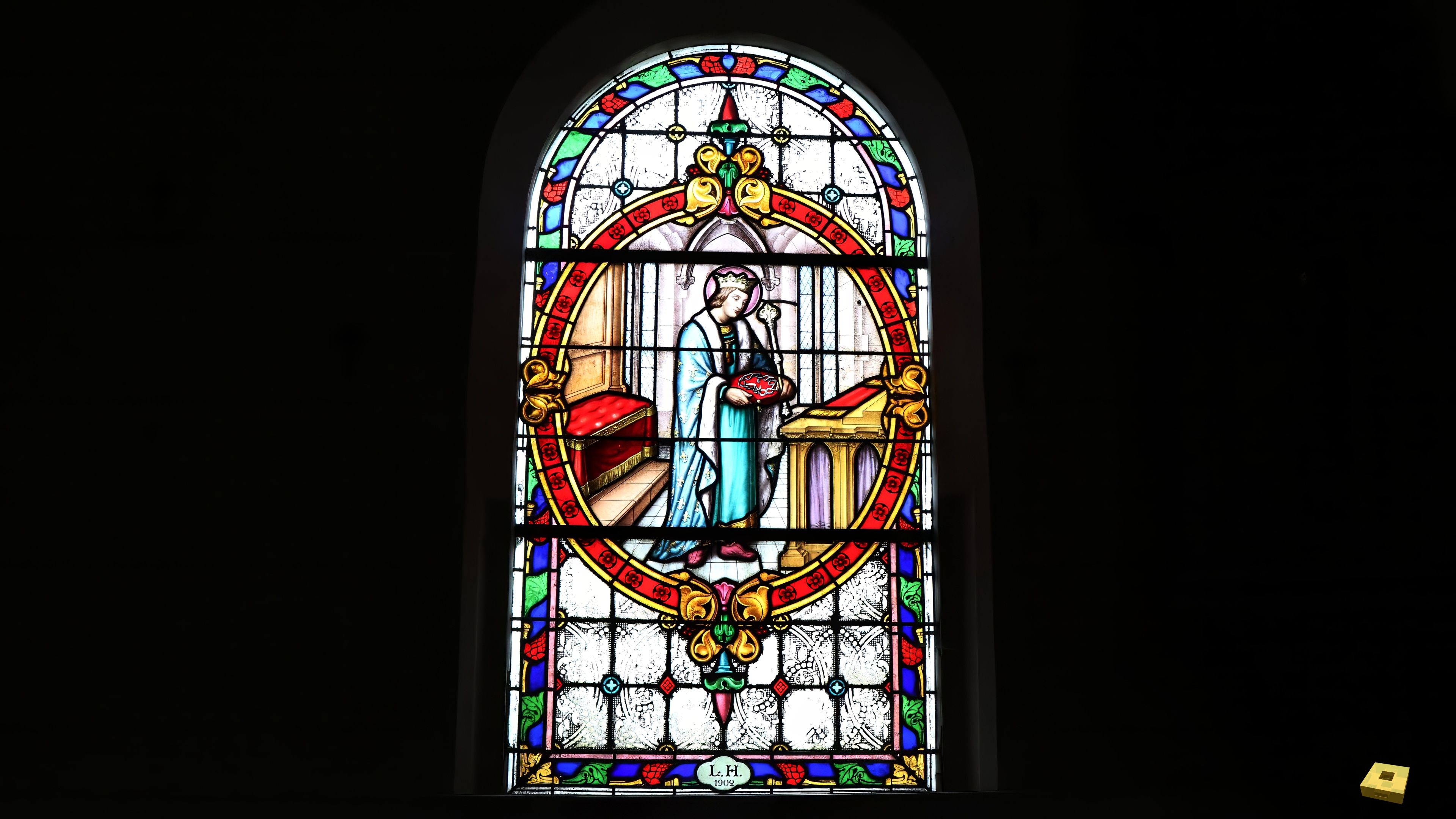
This stained glass window, dated 1909 (“L.H. 1909”), depicts a crowned and haloed royal figure, probably Saint Louis, King of France. The scene centers on an offering before an altar, with a crucial detail: Christ’s crown of thorns, placed on a red cushion. This symbol, at the heart of Saint Louis’ iconography, confirms his role in preserving the relics of the Passion. The king is depicted in a posture of humility, slightly inclined, holding the crown of thorns on the red cushion toward the altar. He wears a blue cloak decorated with golden fleurs-de-lys and a scepter. To the left is a throne with a red seat, to the right the altar covered with a red cloth. The work is richly colored, with a palette dominated by red, blue and gold, framed by a neo-Gothic border decorated with floral motifs and scrolls.This stained glass window, dated 1909 (“L.H. 1909”), depicts a crowned and haloed royal figure, probably Saint Louis, King of France. The scene centers on an offering before an altar, with a crucial detail: Christ’s crown of thorns, placed on a red cushion. This symbol, at the heart of Saint Louis’ iconography, confirms his role in preserving the relics of the Passion. The king is depicted in a posture of humility, slightly inclined, holding the crown of thorns on the red cushion toward the altar. He wears a blue cloak decorated with golden fleurs-de-lys and a scepter. To the left is a throne with a red seat, to the right the altar covered with a red cloth. The work is richly colored, with a palette dominated by red, blue and gold, framed by a neo-Gothic border decorated with floral motifs and scrolls.
This stained glass window, dated 1909 (“L.H. 1909”), depicts a crowned and haloed royal figure, probably Saint Louis, King of France. The scene centers on an offering before an altar, with a crucial detail: Christ’s crown of thorns, placed on a red cushion. This symbol, at the heart of Saint Louis’ iconography, confirms his role in preserving the relics of the Passion. The king is depicted in a posture of humility, slightly inclined, holding the crown of thorns on the red cushion toward the altar. He wears a blue cloak decorated with golden fleurs-de-lys and a scepter. To the left is a throne with a red seat, to the right the altar covered with a red cloth. The work is richly colored, with a palette dominated by red, blue and gold, framed by a neo-Gothic border decorated with floral motifs and scrolls.


