


 Fort Bévaux, information
Click on the image to go full screen.
Located next to the dolmen!
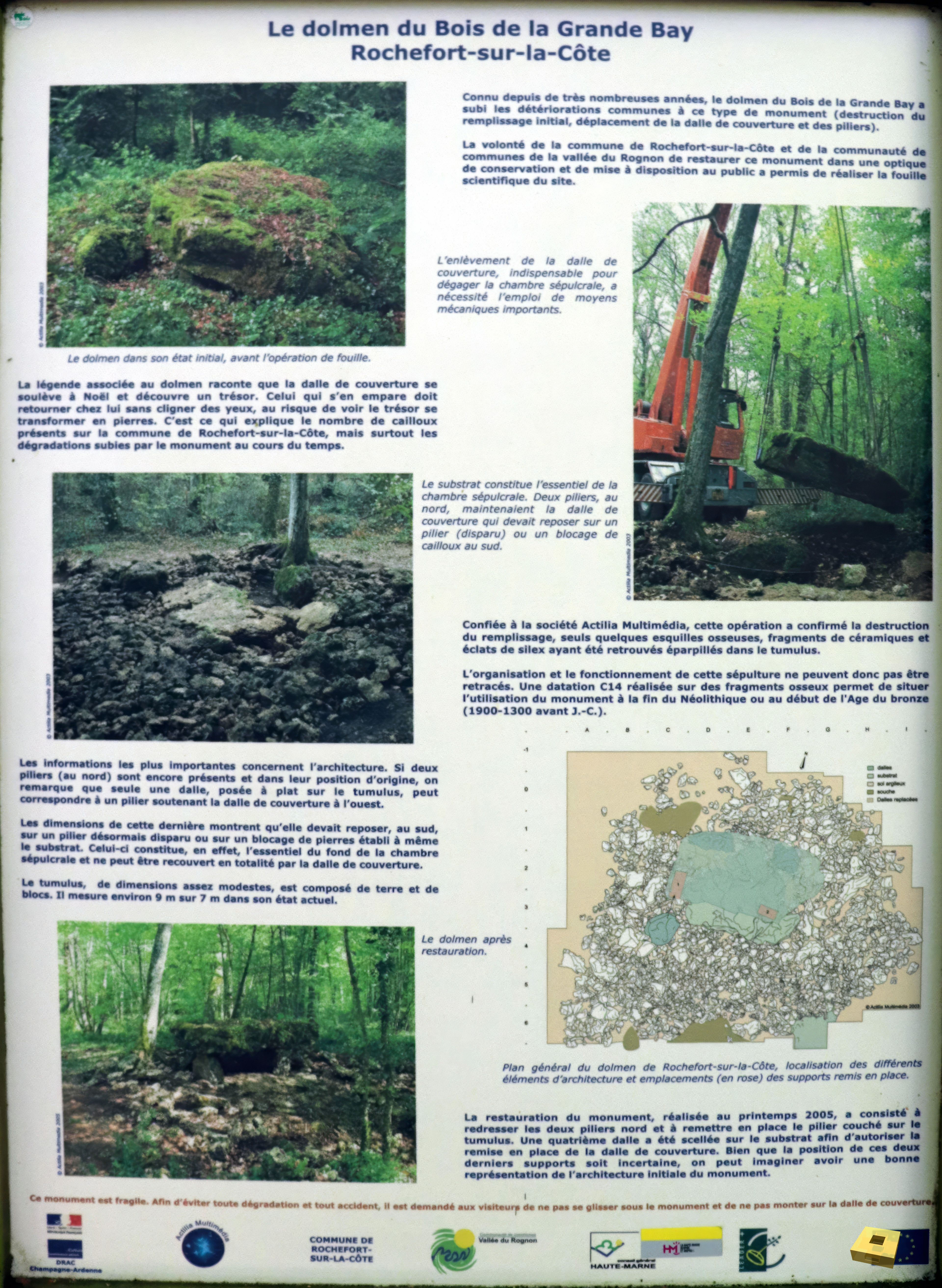
The dolmen in its original state, before the excavation operation.
The legend associated with the dolmen says that the cover slab lifts up at night and reveals a treasure. Whoever seizes it must return home without blinking, at the risk of seeing the treasure turn into stones. This explains the number of stones present in the commune of Rochefort-sur-la-Côte, but especially the damage suffered by the monument over time.
The most important information concerns the architecture. If two pillars (to the north) are still present and in their original position, we note that only one slab, laid flat on the tumulus, can correspond to a pillar supporting the cover slab to the west.
The tumulus, of fairly modest dimensions, is composed of earth and blocks. It measures approximately 9 m by 7 m in its current state.
The dolmen of the Bois de la Grande Bay - Rochefort-sur-la-Côte
Known for many years, the dolmen of the Bois de la Grande Bay is suffering from the deterioration common to this type of monument (destruction of the initial filling, displacement of the cover slab and pillars).
The desire of the commune of Rochefort-sur-la-Côte and the community of communes of the Rognon valley to restore this monument with a view to conservation and making it available to the public has made it possible to carry out the scientific excavation of the site.
The removal of the cover slab, essential to clear the burial chamber, required the use of significant mechanical means.
The substrate constitutes the bulk of the burial chamber. Two pillars, to the north, held the cover slab which must have rested on a pillar (disappeared) or a blockage of stones to the south.
Entrusted to the company Actilia Multimédia, this operation confirmed the destruction of the filling, with only a few bone splinters, ceramic fragments and flint flakes having been found scattered in the tumulus.
The organization and functioning of this burial cannot therefore be traced. A C14 dating carried out on bone fragments makes it possible to situate the use of the monument at the end of the Neolithic or at the beginning of the Bronze Age (1900-1300 BC).
General plan of the Rochefort-sur-la-Côte dolmen, location of the architectural elements and locations (in pink) of the supports put back in place.
The restoration of the monument, carried out in the spring of 2005, consisted of putting back in place the cover slab. Although the position of these last supports is uncertain, we can imagine having a representation of the initial architecture of the monument.

