


 Vaucouleurs, church - Jeanne
Click on the image to go full screen.
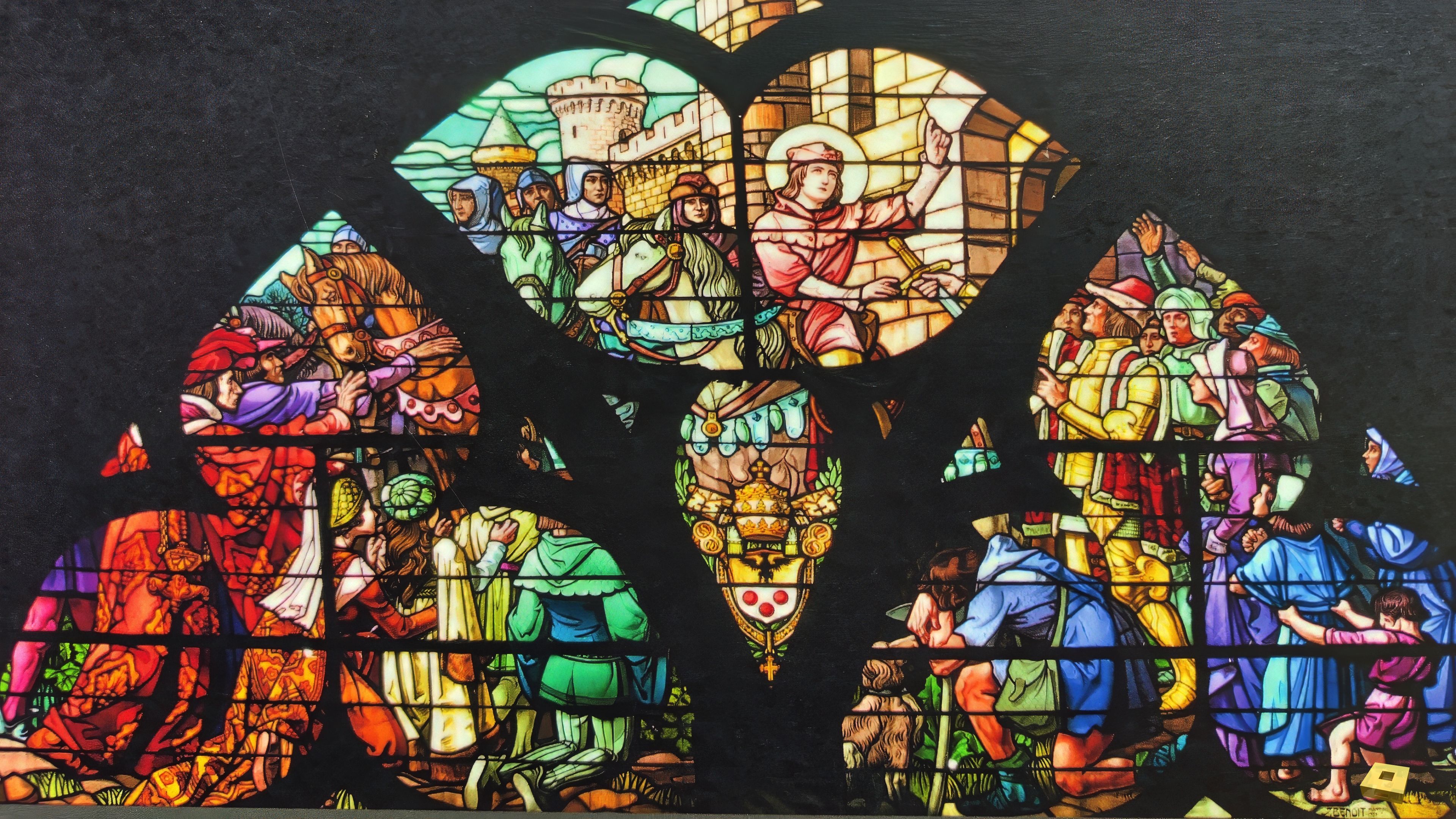
The scene depicted is probably the one where Joan of Arc leaves Vaucouleurs to go to the Dauphin.
This stained glass window from Vaucouleurs seems to represent an important historical scene related to Joan of Arc and her mission to meet the Dauphin (future Charles VII) in order to liberate France during the Hundred Years' War. Here is an analysis of the visible elements and characters. The central character is probably Joan of Arc, identifiable by her central role and her determined attitude. Joan is represented in armor or in traveling attire, with a halo to symbolize her holiness. The gesture of the raised hand can symbolize her divine mission or her appeal to the people and the authorities to support her mission. The people in armor around Joan may represent the partisans and comrades-in-arms who supported her. One of the men who hands her the sword could be Robert de Baudricourt, captain of Vaucouleurs, who helped Joan to go to the Dauphin. In the background, there are figures of clergymen and nobles. These symbolize the alliance between spiritual power, nobility, and Joan's mission. The buildings in the background, especially the towers and fortifications, reinforce the idea that this is a scene located in a fortified city, probably Vaucouleurs. Figures represent the inhabitants of the city of Vaucouleurs who pray or show their support for Joan of Arc. They emphasize the spiritual and popular impact of her mission. The scene depicted is probably that of Joan of Arc leaving Vaucouleurs to go to the Dauphin, with the support of Robert de Baudricourt and other allies. This moment is crucial in Joan's story, because it is here that she truly begins her mission to liberate France.This stained glass window from Vaucouleurs seems to represent an important historical scene related to Joan of Arc and her mission to meet the Dauphin (future Charles VII) in order to liberate France during the Hundred Years' War. Here is an analysis of the visible elements and characters. The central character is probably Joan of Arc, identifiable by her central role and her determined attitude. Joan is represented in armor or in traveling attire, with a halo to symbolize her holiness. The gesture of the raised hand can symbolize her divine mission or her appeal to the people and the authorities to support her mission. The people in armor around Joan may represent the partisans and comrades-in-arms who supported her. One of the men who hands her the sword could be Robert de Baudricourt, captain of Vaucouleurs, who helped Joan to go to the Dauphin. In the background, there are figures of clergymen and nobles. These symbolize the alliance between spiritual power, nobility, and Joan's mission. The buildings in the background, especially the towers and fortifications, reinforce the idea that this is a scene located in a fortified city, probably Vaucouleurs. Figures represent the inhabitants of the city of Vaucouleurs who pray or show their support for Joan of Arc. They emphasize the spiritual and popular impact of her mission. The scene depicted is probably that of Joan of Arc leaving Vaucouleurs to go to the Dauphin, with the support of Robert de Baudricourt and other allies. This moment is crucial in Joan's story, because it is here that she truly begins her mission to liberate France.
This stained glass window from Vaucouleurs seems to represent an important historical scene related to Joan of Arc and her mission to meet the Dauphin (future Charles VII) in order to liberate France during the Hundred Years' War. Here is an analysis of the visible elements and characters. The central character is probably Joan of Arc, identifiable by her central role and her determined attitude. Joan is represented in armor or in traveling attire, with a halo to symbolize her holiness. The gesture of the raised hand can symbolize her divine mission or her appeal to the people and the authorities to support her mission. The people in armor around Joan may represent the partisans and comrades-in-arms who supported her. One of the men who hands her the sword could be Robert de Baudricourt, captain of Vaucouleurs, who helped Joan to go to the Dauphin. In the background, there are figures of clergymen and nobles. These symbolize the alliance between spiritual power, nobility, and Joan's mission. The buildings in the background, especially the towers and fortifications, reinforce the idea that this is a scene located in a fortified city, probably Vaucouleurs. Figures represent the inhabitants of the city of Vaucouleurs who pray or show their support for Joan of Arc. They emphasize the spiritual and popular impact of her mission. The scene depicted is probably that of Joan of Arc leaving Vaucouleurs to go to the Dauphin, with the support of Robert de Baudricourt and other allies. This moment is crucial in Joan's story, because it is here that she truly begins her mission to liberate France.


